
July 3, 2026
July 3, 2026
Business Equipment Financing: Which Solutions Should You Choose in 2026?

Purchasing a production machine, a commercial vehicle, or computer equipment often ties up tens of thousands of euros all at once. However, this equipment directly affects the company’s production capacity —and thus its revenue for the coming months.
Should we wait until we have the necessary cash on hand, or are there financing options that are faster than a traditional bank loan?
Between leasing, long-term rentals, and specialized equipment loans, every owner of a microbusiness or small business must weigh the trade-offs between cost, flexibility, and the speed at which funds can be obtained. This guide provides an overview of the solutions available to finance your company’s equipment, how they actually work, and how Karmen has reimagined this financing to move faster than a bank—without dilution or debt assignment.
Why Purchasing Equipment Puts Such a Strain on an SME's Cash Flow
Production equipment is generally depreciated over 5 to 10 years using the straight-line method, in accordance with the General Chart of Accounts (PCG); for computer equipment, this period is sometimes as short as 3 years. But this accounting spread does not change the reality of cash flow: the invoice itself must be paid in a single lump sum, often even before the machine generates a single euro in additional revenue. This is the crux of equipment financing: decoupling the payment schedule from the asset’s payback period. This logic aligns with that of companies that seek, more broadly, to finance their investments, whether in R&D, inventory, or production equipment.
ℹ️ Example: An e-commerce business that invests in an automated packaging machine before the fourth-quarter order surge ties up its cash at the worst possible time—just before the period when it needs it most to finance its inventory and logistics.
Leasing, LOA, LLD, and equipment loans: What Are the Practical Differences?
Broadly speaking, there are four main categories of solutions for financing equipment:
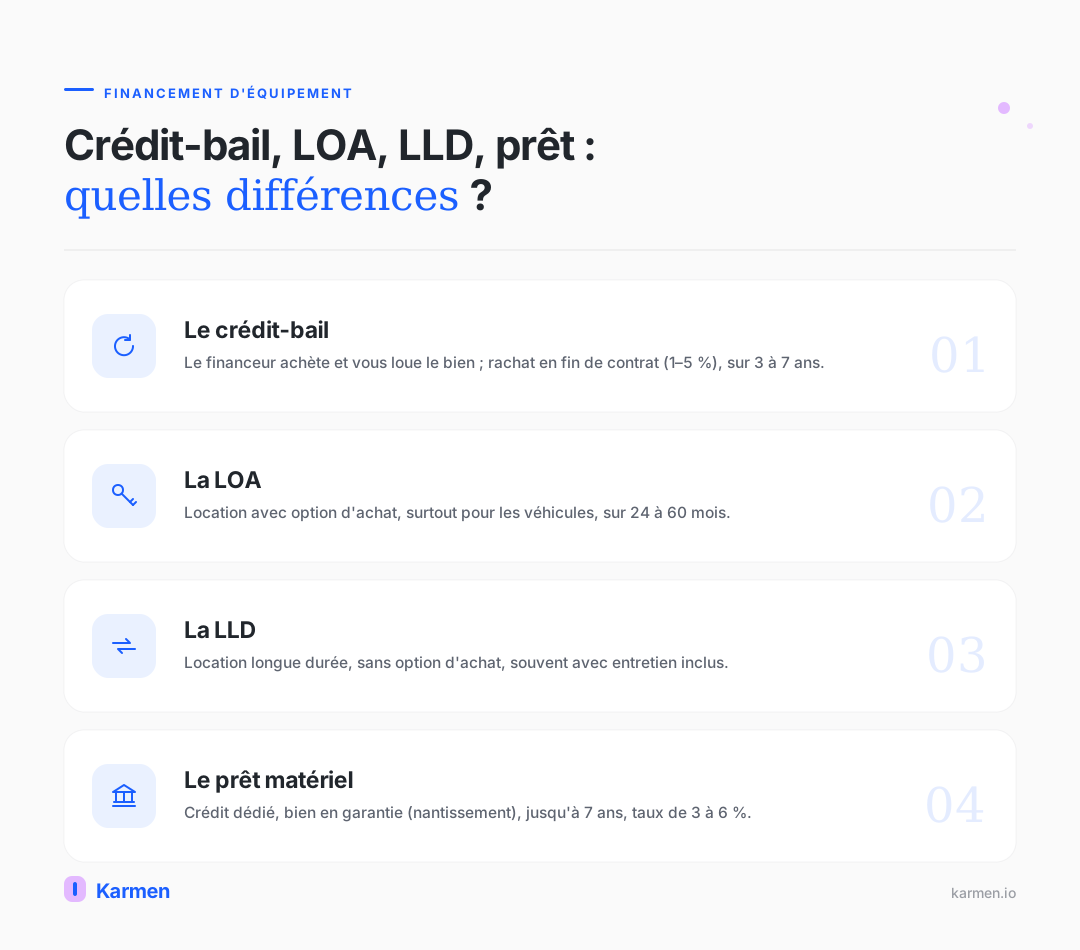
- Leasing: The financing company purchases the asset and leases it to you, with an option to purchase it at the end of the contract (residual value generally between 1% and 5% of the initial price), for a term of 3 to 7 years.
- Lease-to-own (LOA): a similar arrangement, used primarily for vehicles, with terms ranging from 24 to 60 months.
- Long-term lease (LTL): no option to purchase; usage takes precedence over ownership; often combined with a maintenance contract.
- The traditional equipment loan: a dedicated bank loan secured by the equipment (collateral), with a term of up to 7 years and an interest rate generally ranging from 3% to 6%.
The accounting treatment also varies depending on the option chosen: a finance lease is recognized as a deductible expense without being recorded as an asset on the balance sheet (excluding IFRS 16), whereas a traditional equipment loan records the asset as an asset and the debt as a liability, with a direct impact on the debt ratios monitored by your financial partners.
The Limitations of Traditional Bank Financing for Equipment
On paper, a bank loan is often the least expensive option. In practice, however, it involves a processing time of 4 to 8 weeks, a personal guarantee from the CEO, and sometimes covenants that can constrain future financing cycles. For a company in the manufacturing sector that needs to replace a broken machine before a customer’s due date, this delay can quite simply cost the company the contract. Should a company really tie up its cash or wait two months for the bank to process the loan just to purchase equipment that, once in operation, will generate the very cash needed to repay it?
Equipment financed at the right time doesn't cost cash—it generates it.
We launched Karmen Loan to finance equipment without transferring debt
It was this observation that led to the creation of Karmen Loan: financing ranging from €30,000 to €5 million, for a term of 1 to 24 months, with a decision within a few days and no assignment of debt. Unlike leasing or traditional bank loans, the company retains ownership of the asset immediately upon purchase, without having to wait for a buyback option at the end of the contract, and without having to provide personal guarantees that are disproportionate to the amount borrowed. For companies that already manage multiple lines of financing, such as funding new hires or funding advertising campaigns, the equipment becomes another building block of the same mechanism: financing growth without diluting equity or tying up capital on the balance sheet.

How to Choose the Right Solution for Your Needs
The right choice depends on four main criteria:
- The expected useful life of the equipment (equipment that becomes obsolete in 3 years is not financed in the same way as a machine depreciated over 10 years).
- Whether or not you need to retain ownership of the property in the long term.
- The desired impact on the balance sheet and debt ratios.
- The speed at which cash must be available.
ℹ️ Example: An industrial SME that needs to replace an aging machine tool in the middle of peak season cannot afford to wait two months for bank approval; rapid financing—even if it is slightly more expensive than a traditional loan—is often the best economic option once the cost of production delays is factored in.
Does long-term leasing really offer more flexibility than a traditional loan, once early termination penalties are taken into account? Not always: it all depends on the actual rate at which the company renews its equipment fleet.
Where does the equipment fit in among the company's other sources of financing?
Equipment financing is just one part of a company’s overall financing plan. From the moment a business is founded, the business plan must anticipate financing needs related to equipment, working capital requirements (WCR), and the cash needed to cover the first few months of operation. Available sources of financing include:self-financing (using the company’s own cash reserves or cash on hand),a personal contribution from the owner, an interest-free loan—which can help finance part of the personal contribution needed by start-ups—and crowdfunding (either debt or equity).
Each solution has a different impact on the company's cash flow. Traditional medium-term bank loans are repaid in fixed monthly installments, with payment dates that must be factored into available working capital. Conversely, short-term financing tools such as factoring or an overdraft facility allow companies to smooth out occasional cash flow needs without tying up capital for several years. Leasing, as mentioned above, remains one of the most commonly used options for equipment, as it converts a purchase into installment payments that are, in practice, similar to those negotiated with a traditional bank.
A company must always weigh the cost of the chosen loan against the increase in production that the equipment will bring, to ensure that even a sound investment does not place too much strain on its cash flow. Karmen Loan seeks to simplify this big-picture view of business financing, complementing traditional bank financing sources.
Building a Solid Proposal for Equipment Funding
Regardless of the solution chosen, a well-prepared proposal always speeds up the decision-making process: a detailed quote, a projected usage plan for the equipment, and the expected impact on revenue. These elements are the same as those needed to put together a broader financing proposal . Well-financed equipment is not an expense—it is a production lever that can be put to immediate use, provided you choose the financing structure that best fits your own cash flow rhythm.


