
September 4, 2026
September 4, 2026
Business Cash Flow Loans: A Comprehensive Guide for 2026

A customer who pays six weeks late, a seasonal order to fulfill before payment is received, a surge in business that depletes cash reserves without any capital investment involved: the need for working capital is almost always immediate. The problem is that business working capital loans remain one of the hardest types of financing to obtain from a traditional bank. Why is there such a wide gap between the urgency of the need and the slowness of the response? The reason lies in the very nature of this type of loan: it finances neither an asset nor an identifiable project, but only a timing discrepancy between cash inflows and outflows.
What is a business cash advance?
A business cash flow loan is a short- or medium-term loan intended to cover a cash flow need that is not tied to a specific investment. Unlike an equipment loan or a business mortgage, it is not used to purchase machinery, premises, or a vehicle: it is intended to bridge a temporary gap between what the business owes and what it has actually collected. It differs from two similar types of financing: the business loan in the broad sense, which can finance any business need, and more specific arrangements such as factoring, which are based on the assignment of receivables rather than on a simple loan.
From an accounting perspective, this type of financing generally appears on the liability side of the balance sheet under short-term financial liabilities. Its term typically ranges from 1 to 24 months, with amounts ranging from a few tens of thousands of euros for a very small business to several million for a fast-growing small or medium-sized enterprise. It is this lack of a specific purpose that makes the application difficult to understand for a banker accustomed to financing identifiable assets.
There are several options depending on the term and how the funds are made available. A traditional working capital loan is disbursed in a single lump sum, with a fixed repayment schedule, which is suitable for a one-time, specific need. In contrast, a revolving credit line allows you to draw down and repay funds as needed, which is better suited to recurring needs. In between these two options, some lenders offer repayment plans indexed to actual revenue, which smooths out the repayment burden during slower months rather than imposing a fixed monthly payment regardless of business activity.
The Relationship Between Cash Advances and Working Capital Needs
A business cash loan should never be viewed in isolation: it almost always serves to bridge a gap identified by the working capital requirement calculation. Working capital requirements measure the gap between what the company needs to finance (inventory, accounts receivable) and what it already finances through its suppliers. When receivables linger because payment terms are lengthening, or the collection of overdue payments is delayed, working capital requirements rise—and with them, the company’s cash flow needs.
Working capital, on the other hand, reflects the company’s financial structure: it indicates whether stable financial resources (equity, long-term debt) are sufficient to cover fixed assets. Positive working capital combined with excessively high working capital requirements can still lead to cash flow difficulties, which explains why two companies with comparable income statements may show very different financing needs—or even multiple financing needs. This is where short-term financing solutions come into play: factoring, shareholder line of credit, or dedicated short-term loans—each addresses a different type of cash flow gap.
Creating a month-by-month cash flow forecast allows a company to anticipate these deadlines rather than being caught off guard by them. By monitoring changes in accounts receivable and actual cash flows, a company can identify liquidity pressures and its cash needs several weeks before they become critical, and can seek financing at the right time rather than in a rush.
Why Traditional Banks Are Reluctant to Provide Working Capital Financing
An equipment loan finances a machine that the bank can repossess in the event of default. A commercial real estate loan finances a property that serves as collateral. A working capital loan, on the other hand, does not finance anything tangible: in the event of default, there is nothing to recover. Structurally, this is the type of loan that traditional banks like the least, as it involves pure risk without any physical collateral.
This reluctance manifests itself in three concrete ways. First, personal guarantees are often required (a personal guarantee from the CEO, pledging of company shares). Second, a financial history spanning several fiscal years is required even before the application is reviewed, which effectively excludes companies that are less than two or three years old. Finally, the review process frequently drags on for several weeks, even though the need for cash is, by definition, urgent. This situation could be summarized as follows: financing is only useful if it arrives while the problem still exists, not six weeks after it has resolved itself or worsened.
Situations That Justify a Business Cash Advance
The need to finance working capital does not necessarily indicate that a company is in trouble; it most often reflects a normal lag between the pace of sales and the pace of cash inflows. A few situations come up regularly:
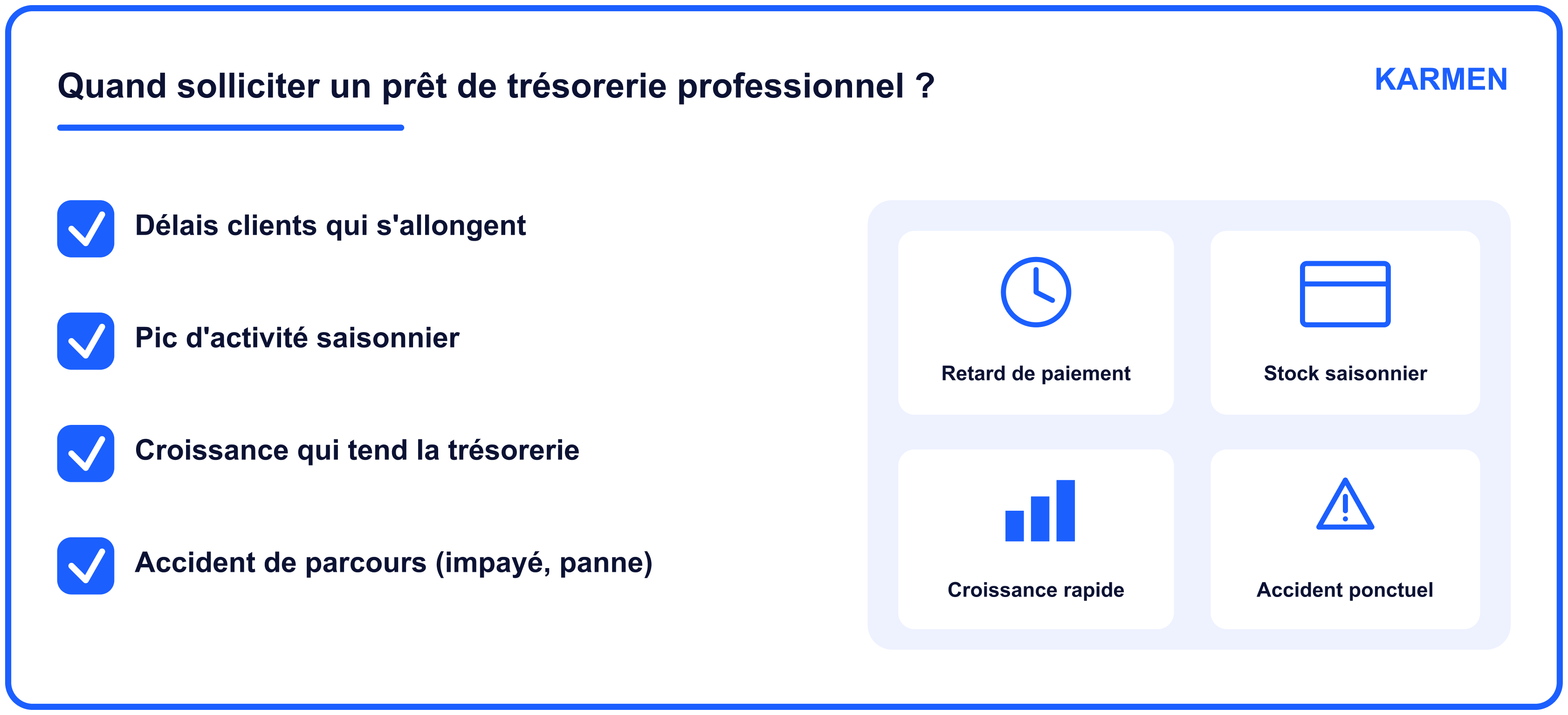
- Customer payment terms are getting longer, while suppliers are demanding prompt payment
- A seasonal peak in activity (back-to-school season, end-of-year holidays) that requires building up inventory before sales are made
- Rapid revenue growth that, paradoxically, strains cash flow rather than strengthening it
- A one-time setback (unpaid bill, delayed grant, equipment failure) that creates a temporary cash shortfall
ℹ️ A ready-to-wear e-commerce retailer that must build up its winter inventory as early as September—even though sales won’t come in until November and December—clearly illustrates this time lag: the need for cash precedes the cash inflows that will cover it by several months.
This type of tension can also be structured through a line of credit—a revolving line of credit—rather than a traditional loan disbursed in a single lump sum. Both meet the same need, but offer different levels of flexibility depending on whether the cash flow gap is one-time or recurring.
The actual criteria considered by an alternative lender
Should a working capital loan really be analyzed using the same criteria as an investment loan? No, and that is precisely what alternative financing providers do. Rather than looking for an asset to use as collateral, they examine the company’s actual cash flows:
- Revenue over the past 12 months and its consistency are more revealing than a snapshot balance sheet
- Recurring payments (subscriptions, recurring orders, framework agreements)
- Short-term repayment capacity, calculated based on actual cash flows rather than a theoretical projection
- The length of time the company has been in business—generally at least one year rather than three
This changes everything when it comes to processing times. Where a bank takes several weeks, a fast business loan obtained through automated account analysis can be approved within 48 hours. ℹ️ A B2B distributor facing 60-day payment delays from three of its largest customers was able, thanks to this type of analysis, to receive a financing decision in two days—compared to over a month during its previous bank application.
The cost, for its part, generally takes the form of a fixed fee based on the amount financed rather than a traditional interest rate, which makes it easier for a business owner—who may not have time to compare APRs—to understand the price. This fee typically ranges from 3% to 8% of the total amount financed, depending on the chosen term and the company’s risk profile. It is disclosed before the contract is signed, which avoids unpleasant surprises related to application fees or prepayment penalties that are sometimes found in traditional bank offers.
We launched Karmen Loan to provide working capital without having to wait for the bank
This is precisely the observation that led to the creation of Karmen Loan: a business working capital loan ranging from €30,000 to €5 million, with a term of 1 to 24 months, and a quick decision based on an analysis of the company’s financial statements rather than on personal guarantees. The financing is provided without the assignment of debt, which allows the business owner to maintain full control over their relationships with customers and suppliers.
For companies with a large inventory that is otherwise difficult to liquidate, the inventory pledge offering through Karmen Loan allows them to obtain a loan equal to the value of that inventory, as determined by a recognized third party (Auxiga, with approximately 50 years of expertise in inventory collateral). The inventory remains under the owner’s control—there is no transfer of ownership—and simply needs to be consolidated in a single location for valuation purposes.
.png)
How long does it take to make a decision?
Is it really reasonable to wait six weeks for a response from the bank when the cash shortfall is growing every day? The answer depends mainly on the nature of the need. For a one-time, predictable shortfall, a cash advance is often enough to tide the company over without committing it to a long-term arrangement. For a more structural need—such as one linked to sustained growth or a business cycle that is lengthening over the long term—a traditional working capital loan, with a fixed repayment schedule, offers greater visibility.
In both cases, the best approach remains the same: don’t wait until cash reserves run dry to take action, and choose a partner capable of evaluating the case based on actual cash flows rather than on assets that may not always exist in a service or e-commerce company.


