
September 22, 2026
September 22, 2026
Financial Assistance for Growing Businesses: What Are the Options?

Revenue is rising, teams are expanding, and inventory is growing. And yet, the bank account is running low. This is the paradox of fast-growing companies: growth consumes cash long before it generates any.
Faced with this gap, the natural instinct is to seek financial assistance. Grants, tax credits, low-interest loans, government guarantees, and repayable advances: there are numerous programs available, many of which can be combined, yet they are largely underutilized by microbusinesses and small and medium-sized enterprises (SMEs). But assistance is only valuable if it arrives when funds are needed. What good is an €80,000 grant paid out in nine months when inventory needs to be paid for this quarter?
This guide provides an overview of the financial assistance available to growing businesses, the actual requirements for obtaining it, its limitations, and how to supplement it when the government’s timeline does not align with the business’s schedule.
Financial assistance isn't just a grant
In everyday language, financial aid is often confused with a grant—that is, money provided with no obligation to repay. The reality is broader. A support program is any form of government intervention that improves a company’s financing conditions: by providing funds, offering low-interest loans, guaranteeing a bank loan, or reducing taxes. Each of these forms has a radically different cash flow mechanism.
This distinction matters a great deal to a growing company. A €50,000 grant funds a specific project, one that is often already underway. A public guarantee does not provide a single euro but can unlock a €300,000 bank loan that the bank would have refused on its own. A tax credit improves the bottom line but does not translate into cash until the following year. The right approach, therefore, is not to seek out the most generous aid, but rather the aid whose timing aligns with the company’s needs. This is the logic that underpins the entire financing of business growth : each tool is designed for a specific point in the cycle.
The main categories of available assistance
Regardless of the agency, the programs fall into five categories that it is helpful to distinguish before submitting any application:
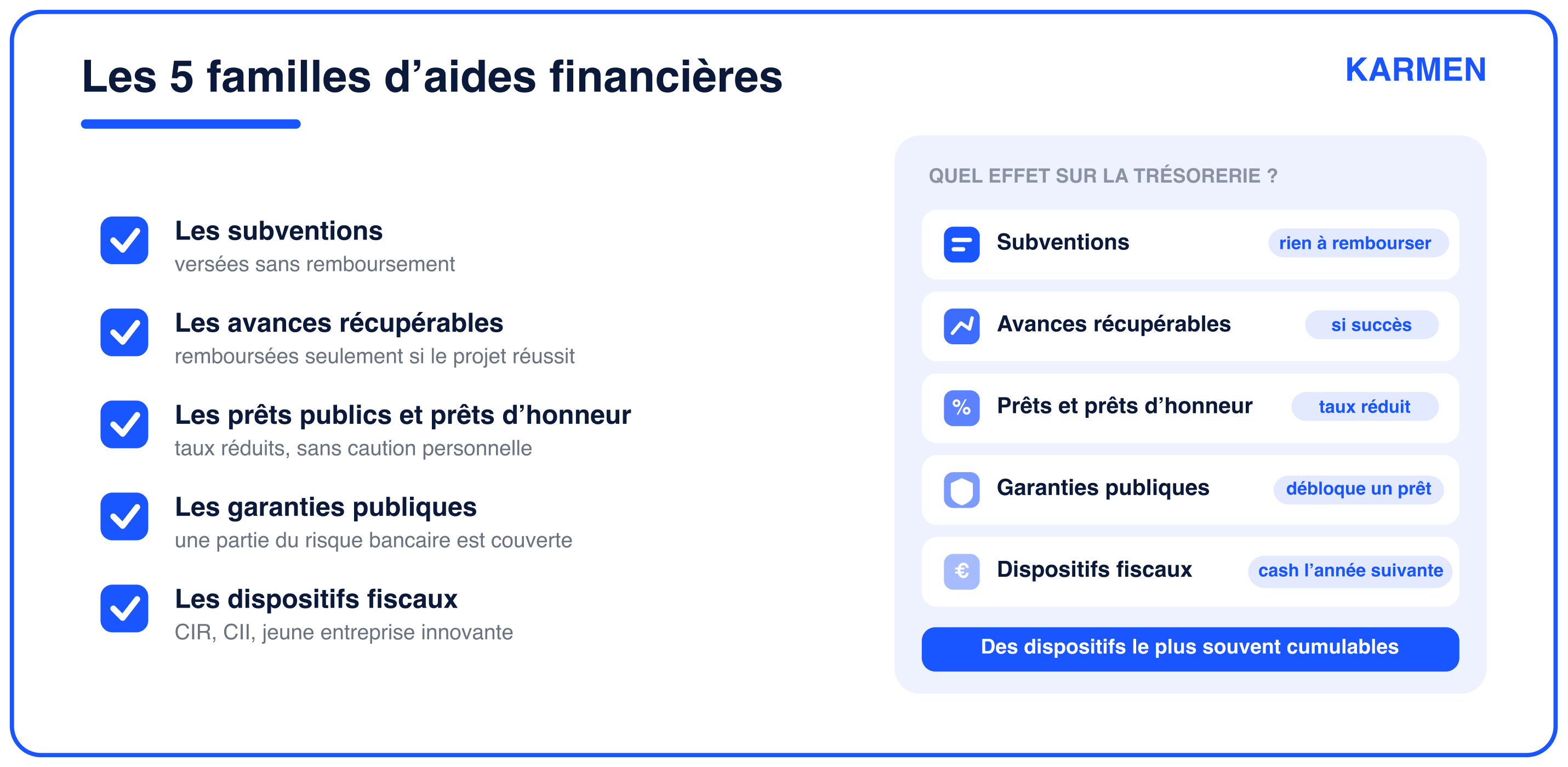
- Grants: a sum of money provided without repayment, tied to a specific project (innovation, exports, hiring, ecological transition)
- Recoupable advances: an interest-free loan that is repaid only if the project succeeds
- Public loans and honor loans: reduced interest rates, deferred repayment, and, in most cases, no personal guarantee required
- Government guarantees: The agency covers part of the risk to secure bank financing
- Tax Incentives: Research Tax Credit, Innovation Tax Credit, Young Innovative Company Status
On the operator side, Bpifrance remains the main gateway: innovation grants, unsecured loans, and guarantees covering up to 60% of a bank loan, depending on the program. The regions tend to finance capital investments, commercial real estate, and international expansion. The research tax credit, meanwhile, covers 30% of eligible R&D expenses up to €100 million in spending, making it the most powerful tool for a technology company. The innovation tax credit applies to prototyping and design expenses, up to a limit of €400,000 in annual expenses for SMEs. If your growth relies on ongoing technical development, these mechanisms should be incorporated into your financing plan well in advance, just like solutions for fund your R&D projects.
Why Government Aid Rarely Keeps Pace with Growth
This is the blind spot in most financing plans. Between the submission of a grant application and the first payment, there is often a three- to six-month review period. The payment itself is rarely made in full: an initial installment at the start, with the balance paid after submitting proof of expenses—sometimes a year later. In other words, the company covers the expense with its own cash flow and is reimbursed later.
For a growing company, this mismatch comes at the worst possible time. Working capital needs automatically increase as business grows: more inventory to finance, more outstanding accounts receivable, and more salaries to pay before any cash comes in.The squeeze effect is a classic phenomenon, and it puts even perfectly profitable companies in a difficult position.
ℹ️ Example: An e-commerce business preparing for the fourth quarter orders its inventory in August and pays for it within 30 days, even though sales won’t come in until November and December. A regional investment grant, as welcome as it may be, does nothing to address this specific payment deadline.
A grant funds a project. Financing sustains growth. A growing company needs both, though rarely at the same time.
This doesn't mean you should give up on government programs—quite the contrary. It means you should apply for them early, with a solid application, and without basing your cash flow plan on when the funds will be disbursed. Knowing how to how to put together a solid funding proposal remains the best way to speed up the review process and avoid back-and-forth exchanges that delay funding by several weeks.
Combining Public Aid and Private Funding
Companies that finance their growth most effectively don’t choose between government grants and private financing. They combine the two, using each tool for its intended purpose. Four criteria help make a quick decision:
- The nature of the need: a one-time, specific project is a good candidate for assistance, whereas a recurring cash flow need is not
- The timeline: if the money is needed within a month, no public program will be able to meet that deadline
- The true cost: Free assistance that requires twenty days of in-house work isn't really free
- Leverage: Some grants require that private funding have already been secured before they are disbursed
This last point is often misunderstood. Many programs operate on a co-financing basis: the public agency contributes only a fraction of the project’s cost, provided that the remainder is covered. Securing private funding is therefore not an admission of failure on the part of the public sector; it is often a prerequisite for access to such programs. To make an informed decision, it is helpful to compare the best financing options for an SME before finalizing its plan.
ℹ️ Example: An industrial SME that incurs €400,000 in R&D expenses will receive its research tax credit in the year following the fiscal year in question. Rather than waiting, it can pre-finance this tax credit and use the funds immediately to hire the engineers who are responsible for generating these expenses. How many companies have missed out on a market opportunity because the money existed on paper but not in their bank account?
We launched Karmen Loan to finance growth without having to wait for government funding
We built Karmen Loan specifically to address this timing gap. The companies we work with have no shortage of projects or profitability; they simply lack cash flow at the exact moment they need to purchase inventory, launch a customer acquisition campaign, or hire staff ahead of the peak season. Karmen Loan provides financing ranging from €30,000 to €5 million, for terms of 1 to 24 months, with a quick response and no debt assignment or equity dilution.
For companies whose growth is primarily reflected in their inventory, we also offer an inventory pledge solution: the credit is based on the valuation of the goods, conducted by Auxiga, the European leader in inventory financing with nearly fifty years of expertise. The inventory must be consolidated in a single location but remains under the owner’s control, without any loss of possession or disruption to business operations. This mechanism of inventory pledge financing remains largely unknown, even though it transforms a dormant asset into available working capital.
The goal is not to replace government aid, which offers one of the best cost-benefit ratios in business financing. It is to ensure that the slow pace of government aid never becomes a bottleneck for your growth.

Key takeaways
Financial assistance for growing businesses forms a rich but slow-moving ecosystem. Grants, repayable advances, subsidized loans, guarantees, and tax credits cover a significant portion of your projects’ costs—provided you plan ahead and are willing to accept payment timelines measured in months. The financing plan for a rapidly growing business is therefore built on two tracks: public programs to reduce the cost of key projects, and rapid private financing to meet the working capital needs that growth creates day after day. It is the combination of the two—never one at the expense of the other—that allows the business to keep pace.


