
September 25, 2026
September 25, 2026
Everything You Need to Know About the Brewer Loan

Taking over a café, bar, or brasserie requires a significant upfront investment: the cost of the business or shares, renovations, equipment, and the first few months of operation. Faced with banks that often require a 30% down payment, many business owners are discovering a financing option specific to the café, hotel, and restaurant sector: the “brasseur” loan.
The concept can be summed up in one sentence. A beverage supplier lends you money, and in exchange, you agree to buy your beer, coffee, or soft drinks from them for several years. It sounds simple on paper, but it’s much less so when you look at the details of the terms, the actual cost, and what the loan doesn’t cover.
This guide provides an overview of how a brewer's loan works, the exclusivity agreement that accompanies it, its implicit cost, and its role in the financing structure of a business acquisition.
What is a brewer's loan?
A brewer’s loan, also known as a brewer’s credit or beer contract, is financing provided by a beverage supplier to the operator of a bar or restaurant. The lender is not necessarily a brewer in the strict sense. It could be an industrial brewer, a wholesaler that distributes multiple brands, or a coffee roaster that supplies coffee machines to bars. It is a form of non-bank financing, just like other solutions for obtain credit without going through a bank.
The supplier's support takes several forms, which are often combined in a single contract:
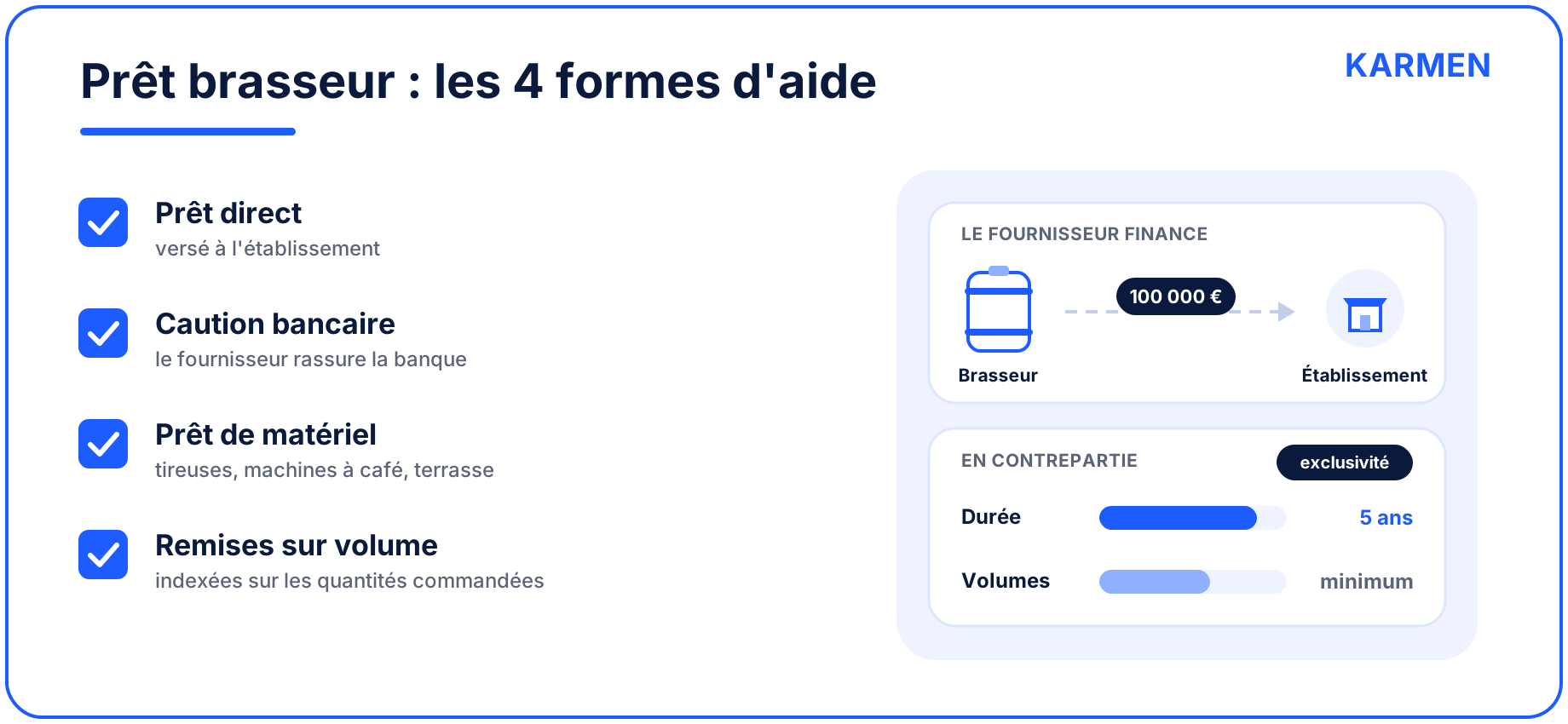
- Direct loan: The supplier pays a sum to the institution, which is repaid over the term of the contract.
- Bank guarantee: The supplier acts as a guarantor for part of the loan, which reassures the bank and strengthens the application.
- Equipment rental: beer dispensers, coffee machines, refrigerated display cases, and patio furniture are available.
- Volume discounts: a discount on the price of products based on the quantity ordered.
Why would a supplier take this risk? Because a well-established establishment represents guaranteed sales volumes for years to come. A brewery loan is a business tool first and a financial tool second: the supplier is buying market share—in this case, the bar counter of a brewery that sells several hundred hectoliters per year.
How is a brewer's loan repaid?
This is where a brewer’s loan differs from a traditional loan. In most cases, no monthly payments are made to the lender. Repayment is built into the purchase price of the products: the supplier charges a price higher than the market rate, or makes discounts contingent on a minimum volume, for the entire duration of the contract.
The operator therefore feels as though they are receiving a free loan. In reality, they make payments with every order of coffee or coffee barrels. And if the projected volumes are not met, the contract generally provides for repayment of the balance, sometimes accompanied by penalties.
ℹ️ A brewer lends €100,000 to an operator who is taking over a café-brasserie. In return, the establishment agrees to purchase 400 hectoliters of beer per year for 6 years at a price increased by €50 per hectoliter. The additional cost amounts to €20,000 per year, or €120,000 over the term of the contract: €20,000 more than the principal amount of the loan, without any payment ever appearing on the bank statement.
The Exclusivity Agreement: Clauses to Review Before Signing
The loan is never granted on its own. It is tied to an exclusive supply agreement, which prohibits the operator from purchasing the relevant products from a competitor. This exclusivity must be explicitly stated in writing in the contract: it cannot be implied.
Over time, two sets of rules have coexisted. Article L330-1 of the Commercial Code caps the duration of any exclusivity clause at 10 years. However, the European Block Exemption Regulation on vertical agreements (Regulation (EU) 2022/720) does not cover non-compete obligations lasting longer than 5 years. This is why most contracts are signed for 5 years and then renewed. The issue remains a sensitive one: a bill aimed at better regulating these contracts was introduced in the National Assembly in December 2025.
Before signing, be sure to review at least the following points:
- The scope: beer alone or all beverages. A total exclusivity agreement severely limits your freedom when designing the menu.
- Minimum balances: Overestimated quotas can turn a favorable loan into debt that’s due at the worst possible time.
- Termination Penalties: compensation for early termination, reimbursement of the remaining balance, and return of equipment.
- Sale of the fund: Check whether the contract is tied to the fund and is binding on the buyer, as this will affect your resale price.
- The actual consideration: Judges have already voided contracts in which the consideration was deplorably low in light of the exclusivity granted.
A brewer's loan is not negotiated based on its amount, but on its volume: that is where its true cost lies.
For a contract of this duration, having it reviewed by an attorney specializing in distribution law is inexpensive relative to the amounts at stake.
Advantages and Limitations: How Much Does a Brewer Loan Really Cost?
The main advantage of a brewer’s loan is that it reduces the amount of equity required. For a buyer, every euro lent by a supplier is a euro they don’t have to raise from investors, thereby avoiding dilution. It also strengthens the bank’s assessment: the bank sees an industrial partner committed to the deal, which mitigates one of the major obstacles to obtaining a bank loan : the equity requirement.
Its limitations are just as clear. The cost is invisible, as it’s buried in the purchase price. The dependency is real: for five years, you can’t shop around for better deals or switch beers if your customers ask for a different one. And the amount is capped by the volumes you can commit to, since a supplier rarely lends more than what its future margins from your establishment can repay.
Above all, a brewery loan finances a project, not working capital. It is provided at the time of the takeover or renovation, paid out in a lump sum or allocated to equipment, and is not tied to the ups and downs of day-to-day operations. Hospitality businesses share this constraint with other capital-intensive sectors, as shown by financing in the hotel industry, where renovations and seasonality create the same cash flow shortfalls.
Brewer loans, bank loans, mortgage loans: What's Changing for Borrowers
On paper, a brewer’s loan looks like any other loan: a lender, a borrower, a principal amount, and a repayment term. However, the similarities end there. A mortgage, a consumer loan, or a business loan is based on a loan agreement that specifies an interest rate, an amortization schedule, and monthly payments. A brewer’s loan generally does not specify a rate or a repayment schedule: repayments are made through the supplier’s invoices.
As a direct result, the total cost is never disclosed. It must be calculated by the operator: multiply the additional unit cost by the volumes committed over the entire term, then compare that amount to the loan principal. The same logic applies in the event of early repayment. Request the outstanding balance in writing and verify whether the exclusivity agreement expires along with it. As long as this balance remains unpaid, the supplier holds a claim against the business, often secured by a pledge of the business assets or a personal guarantee from the owner.
From the bank’s perspective, the brewer’s loan is a key factor in the review of the application. The banker examines the overall debt level: outstanding balances on existing loans, commitments made to suppliers, and the ability to meet the monthly payments on the acquisition loan. The banker will also require borrower’s insurance for the business owner on the primary loan, just as with a mortgage. And if the building is sold along with the business, that real estate will be financed separately, over a much longer term than that of a brewery loan agreement.
The best approach is to include everything in a financing plan, attached to the business plan submitted with the loan application. On one hand, the expenses: purchase price, renovations, fixed assets (equipment, interior design, patio), and startup working capital needs. On the other hand, the resources: personal contribution, partners’ checking account, bank loans, brewer loans, and any vendor credit. The two columns must balance each other, and the business must maintain a cash reserve to cover unforeseen expenses.
Where does the brewer's loan fit into the structure of a business acquisition?
When acquiring a brewery, the typical financing structure combines approximately 30% equity and 70% bank debt. The brewer’s loan is deducted from the equity portion. Other financing options are also available: vendor financing, lease-management agreements with a purchase option, and, most importantly, the choice between purchasing the business assets and purchasing the ownership shares.
This last point carries significant weight. The sale of a business is subject to registration fees of 3% for amounts between €23,000 and €200,000, and 5% for amounts above that: approximately €120,000 in fees for a business valued at €2.5 million. Buying out the shares of an SAS costs only 0.1% and allows you to retain the Class IV liquor license, outdoor seating permits, and existing contracts. Indeed, these existing contracts include any brewery contracts held by the seller, which must be reviewed prior to closing.
ℹ️ Two partners are targeting a Parisian brewery with €2 million in revenue (excluding tax) and an EBITDA margin of 16%, a level that has remained stable for the past three years. Target price: €2.5 million, through a share purchase. Their plan calls for 30% equity, or €750,000, with the remainder financed by bank debt. By securing two brewery loans of €100,000 each, they reduce the equity they need to raise by €200,000.
The financing for the acquisition has been finalized. But who will cover the costs for the two months that the brewery will be closed?
We launched Karmen Loan to provide funding for the cash flow that the brewer's loan does not cover
Let’s return to our two partners. Their plan calls for closing the establishment for two months to carry out renovation work. During this period, revenue drops to zero. Expenses, however, continue: salaries for the retained staff, rent, mortgage payments, and down payments to contractors. Their financial projections indicate a cash flow need of nearly €80,000 before the brewery gets back on track.
Their first instinct was to raise additional equity to build up a financial cushion. One of their investors dissuaded them: giving up 5 to 10 percentage points of equity to bridge a gap of a few months makes no sense. Short-term debt, repaid from operating cash flow, costs far less than permanent dilution.
A brewery’s business model lends itself perfectly to this. The business has virtually no accounts receivable: payments are collected in cash, while payment terms for suppliers are up to 60 days from the end of the month. This time lag creates favorable working capital, and cash reserves are quickly replenished once the business reopens. Short-term financing is therefore a natural fit, provided it can be secured quickly.
This is precisely where Karmen Loan steps in—right where the brewer’s loan ends: temporary closure for renovations, hiring a chef, launching a new menu, or funding a marketing campaign for a reopening. Karmen Loan provides financing ranging from €30,000 to €5 million, over a term of 1 to 24 months, with a quick response and no assignment of debt. The funds are deposited into the business’s account, which can use them as needed. No exclusivity, no minimum volume requirements: you remain free to choose your menu and suppliers. To bridge a temporary cash flow gap, it’s the equivalent ofa business working capital loan designed for speed, orbridge financing between a turnaround and a return to financial stability.
Brewer loans: a powerful tool that must be used with care
A brewer’s loan remains one of the most effective tools in the hospitality industry for reducing the amount of equity required during a takeover. However, its cost is reflected in volume, not on a payment schedule, and the contract commits you for at least five years. Negotiate the scope, quotas, and exit terms with as much care as you do the loan amount.
And when preparing your budget, make sure to factor in the cash flow for the first few months—the kind that no beverage supplier will cover for you.


