
July 20, 2026
July 23, 2026
Payment Delegation: Definition, Legal Framework, and Alternatives to Consider
.png)
Delegating payment is as fascinating as it is intimidating. Few business leaders truly understand it, even though it protects thousands of small and medium-sized construction companies from unpaid bills every year.
The concept can be summed up in one sentence: instead of waiting for your customer to pay you, you get your customer’s customer to agree to pay you directly.
This mechanism, governed by Articles 1336 through 1340 of the Civil Code, serves both to secure a one-time receivable and to provide a guarantee for a subcontractor on a construction site. However, it is important to understand its conditions, limitations, and the situations in which another financing solution would be far more effective.
Payment Delegation: What Exactly Is It?
Article 1336 of the Civil Code defines delegation as the act by which one person, the delegator, causes another, the delegatee, to assume an obligation to a third party, the assignee, who accepts the delegatee as a debtor. Three parties, three specific roles. The assignee is the original creditor—the one who is to be paid. The delegator is the assignee’s direct debtor. The delegatee is the third party who agrees to settle the debt in place of the delegator, generally because the delegatee is itself a debtor to the delegator.
Once the commitment has been made, the delegatee may not, unless otherwise specified, raise any defense against the delegatee based on its relationship with the delegator. In practical terms, the delegatee may not invoke any commercial dispute it may have with the delegator to delay payment. It is this legal separation that makes the tool so valuable: once the delegation is accepted, payment becomes virtually automatic.
ℹ️ Real-world example: A communications agency bills an industrial SME €40,000 for a brand redesign. This SME is itself owed €60,000 by a distributor. Rather than waiting to collect its own payment, it sets up a payment delegation: the distributor makes a direct payment to the agency in the amount of €40,000, without the agency having to worry about the creditworthiness of its direct client.
Perfect or Imperfect Delegation: Two Systems, Two Levels of Protection
Article 1337 of the Civil Code distinguishes between two forms. In what is known as “perfect” or “novative” delegation, the delegating party is expressly released from its debt: the delegatee agrees to have only one debtor, the delegate. In what is known as “imperfect” or “simple” delegation—the default regime in the absence of an express release—the delegating party remains jointly liable with the delegate. The delegatee therefore retains two debtors instead of one.
This difference is by no means trivial for a creditor seeking to ensure payment:
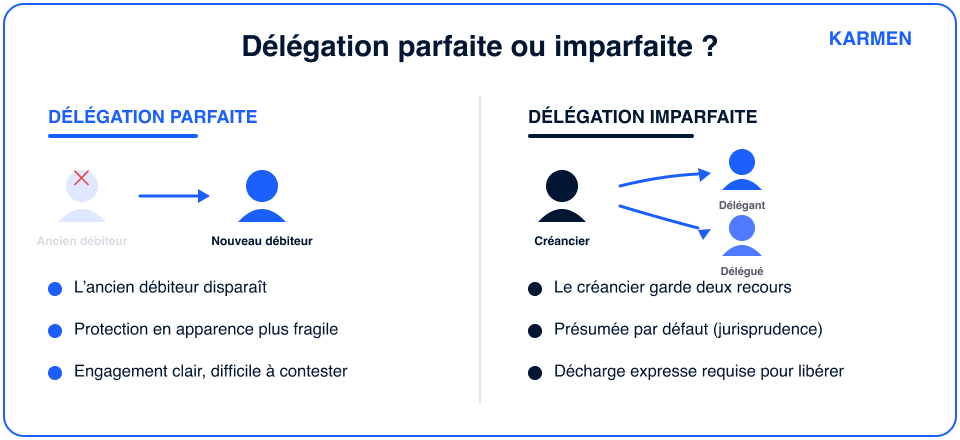
- Perfect delegation: protection that appears more fragile, since the original debtor is no longer involved, but a commitment that is clearer and more difficult to challenge for the new debtor.
- Imperfect delegation: the creditor retains two possible remedies, which explains why case law presumes it by default, unless the delegating party expressly and unequivocally waives it.
In practice, virtually all payment delegations used in commercial transactions and the construction industry are imperfect. They introduce a solvent debtor without eliminating the original obligation, which reassures both parties.
Construction, the number one sector for payment delegation
It is in the construction subcontracting sector that the delegation of payment finds its most practical application. Article 14 of Law No. 75-1334 of December 31, 1975, requires the general contractor—under penalty of nullity of the subcontracting agreement—to provide the subcontractor with either a personal and joint bank guarantee or a delegation of payment from the project owner. This nullity is relative: only the subcontractor may invoke it, and the subcontractor has five years to do so, in accordance with the general statute of limitations set forth in Article 2224 of the Civil Code.
But what happens if the project owner refuses to enter into an agreement with the subcontractor? In that case, the general contractor must then fall back on the bank guarantee, which is the only legal alternative. In public procurement, a similar but distinct mechanism applies: direct payment, as provided for in Article L2193-10 of the Public Procurement Code, which becomes mandatory as soon as the subcontract reaches €600 including tax, for an approved first-tier subcontractor whose payment terms have been approved by the public buyer. This right remains in effect even if the prime contractor goes into judicial liquidation.
ℹ️ Real-world example: A structural contractor subcontracts the electrical work for a construction project to a small craft business for €85,000. Without a bank guarantee available, the contractor sets up a payment delegation arrangement with the project owner. The electrical contractor is then paid directly by the project owner, without having to rely on the main contractor’s cash flow or the progress of its own collections.
Payment Delegation, Dailly Assignment, Receivables Financing: Don’t Confuse Them
These mechanisms are similar in one respect: they all aim to have a debt paid by a third party rather than by the original debtor. Their legal rationale, however, differs profoundly. The assignment of a claim, of which the Dailly assignment is the most common banking form, transfers ownership of the debt itself to a third party—usually a financial institution—which then becomes the holder of the debt. Delegation, on the other hand, transfers nothing: it creates a new obligation between the delegator and the delegatee, without affecting the original relationship between the delegator and the delegatee.
Factoring is more similar to the Dailly factoring process: the company transfers its invoices to a third party in exchange for immediate financing, rather than waiting for payment from its customer. An invoice advance meets the same need for quick cash flow, without going through the sometimes lengthy process of setting up a tripartite agreement. Payment delegation, on the other hand, requires the explicit consent of all three parties, which makes it more cumbersome to negotiate but also more secure once signed.
Accounts receivable, discounts, assignment of receivables: Key terms to master for arbitration
Beyond factoring, there are several techniques for converting accounts receivable into cash before the normal due date. Proper invoicing, with clearly identified accounts receivable, remains the prerequisite for dealing with increasingly long payment terms.
Discounting is the oldest form: a banker advances the amount of a promissory note before its due date, in exchange for a fee. It is a cash advance backed by a specific instrument, for which the beneficiary remains liable if the ultimate debtor fails to pay. This technique constitutes a traditional short-term loan, distinct from the checking account used for day-to-day transactions.
The assignment of receivables, formalized by a statement of assignment (Dailly mechanism), follows a different logic: the assignor transfers its trade receivables to a credit institution, which becomes the creditor of the assigned debtor by subrogation. Without notification, the debtor may still pay its original creditor. Unlike a loan, this short-term financing utilizes existing assigned receivables rather than adding new debt.
Finally, debt collection remains the foundation for dealing with unpaid bills and late payments: reminders, formal notices, and then legal action. Credit insurance covers the risk of insolvency and reduces the working capital requirements associated with outstanding receivables from customers. These solutions are rarely combined with factoring, which is designed for a single receivable rather than for continuously managing working capital.
The Practical Limits of Payment Delegation
Payment delegation has a structural flaw: it depends entirely on the goodwill of a third party who, in principle, has no contractual obligation to you. Without the delegate’s consent, the tool remains purely theoretical.
- It requires the explicit consent of all three parties, which makes it unsuitable for urgent cash flow needs.
- It covers only a specific receivable, which means that a new authorization must be renegotiated for each new contract or each new customer.
- It assumes that the delegate (often the end customer) agrees to assume direct liability, which many refuse to do on principle, even when the law encourages them to do so.
- It does not address recurring receivables from a diverse customer base, each of which, in theory, requires its own tripartite agreement.
Getting paid isn't about convincing a debtor to act in good faith. It's about setting up, in advance, the channel through which the money must pass.
Payment delegation applies this principle to a single receivable. When dealing with a regular flow of customer invoices, a business leader rarely has the time or the leverage needed to negotiate a delegation agreement at each due date. This is where factoring takes over: continuous financing, backed by the entire accounts receivable portfolio, without depending on the approval of a third party outside the business relationship.
We launched Karmen Factor to ensure the collection of your invoices without having to wait for approval from three parties
Do you really need to negotiate a tripartite agreement for every invoice just to have peace of mind? For most small and medium-sized businesses, the answer is no. Karmen Factor finances your customer invoices without assigning receivables and without the delays involved in setting up a payment delegation. The principle is simple: you submit your invoices, Karmen advances the corresponding funds, and collection occurs at the pace of your business rather than at the pace of a three-way negotiation.
Unlike payment delegation, which protects one receivable at a time, Karmen Factor can be applied to an entire accounts receivable portfolio, whether it involves a single invoice or a recurring payment stream. There’s also no need to obtain the end customer’s consent: the business relationship remains direct between you and your customers, with no need for a tripartite agreement to be signed.
To accurately compare the two approaches, our analysis of Karmen Factor versus traditional factoring details the differences in cost, setup time, and contractual flexibility.

In summary
Payment delegation remains the go-to tool for securing a specific receivable, particularly in the construction industry, where the law requires it alongside a bank guarantee. However, it does not replace a solution designed for the entire accounts receivable portfolio. The best approach: use it on a project-by-project, contract-by-contract basis, and turn to factoring as soon as cash flow needs to keep pace with multiple customers at once rather than with a single receivable.


