
July 2, 2026
July 27, 2026
Invoice Management: Methods, Tools, and Solutions for Securing Your Cash Flow
An overdue invoice is simply a figure still outstanding. For many small and medium-sized businesses, it represents a direct component of their working capital needs, with an immediate impact on their ability to pay salaries, suppliers, and operating expenses.
A business leader who neglects invoice management is flying by the seat of their pants. Conversely, a leader who streamlines the process—from issuance to collection—turns an administrative burden into a cash flow lever. This guide details the steps, tools, and financing solutions that enable you to regain control over your invoicing cycle, both on the customer and supplier sides.
Why Invoice Management Is a Cash Flow Issue, Not Just an Administrative One
Many companies treat invoicing as a purely accounting task, delegated to the end of the process. This is a costly mistake. The average payment term for business-to-business transactions in France remains close to 50 days, despite a legal limit of 60 days (or 45 days from the end of the month) set by the LME law. Every additional day of delay ties up cash that could be used to finance growth.
Effective invoice management works on three levels: it shortens payment cycles, reduces the risk of non-payment, and provides reliable visibility into future cash flow. To review the basics of this topic, our overview of how factoring works explains how to turn these invoices into available cash even before they are due.
ℹ️ Real-world example: A trading company with monthly revenue of €200,000 and an average payment term of 55 days ties up approximately €366,000 in working capital at all times throughout its billing cycle. Reducing this payment term by 10 days frees up more than €66,000 without borrowing a single cent.
Why do so many companies tolerate these delays without taking action? Often because following up with customers is seen as a risk to the business relationship, even though a well-handled follow-up is a sign of professionalism, not aggressiveness.
The legal framework, however, provides concrete measures that are rarely utilized. In the event of a late payment, a company may claim a flat-rate compensation of €40 for collection costs, as well as penalties calculated at the contractual rate or, failing that, at three times the statutory interest rate. Few small and medium-sized enterprises (SMEs) apply these measures systematically, even though a simple reminder in the general terms and conditions of sale would deter some chronic late payments.
The steps in a reliable billing process, from issuance to collection
Effective invoice management relies on a series of specific steps, each with its own key considerations:
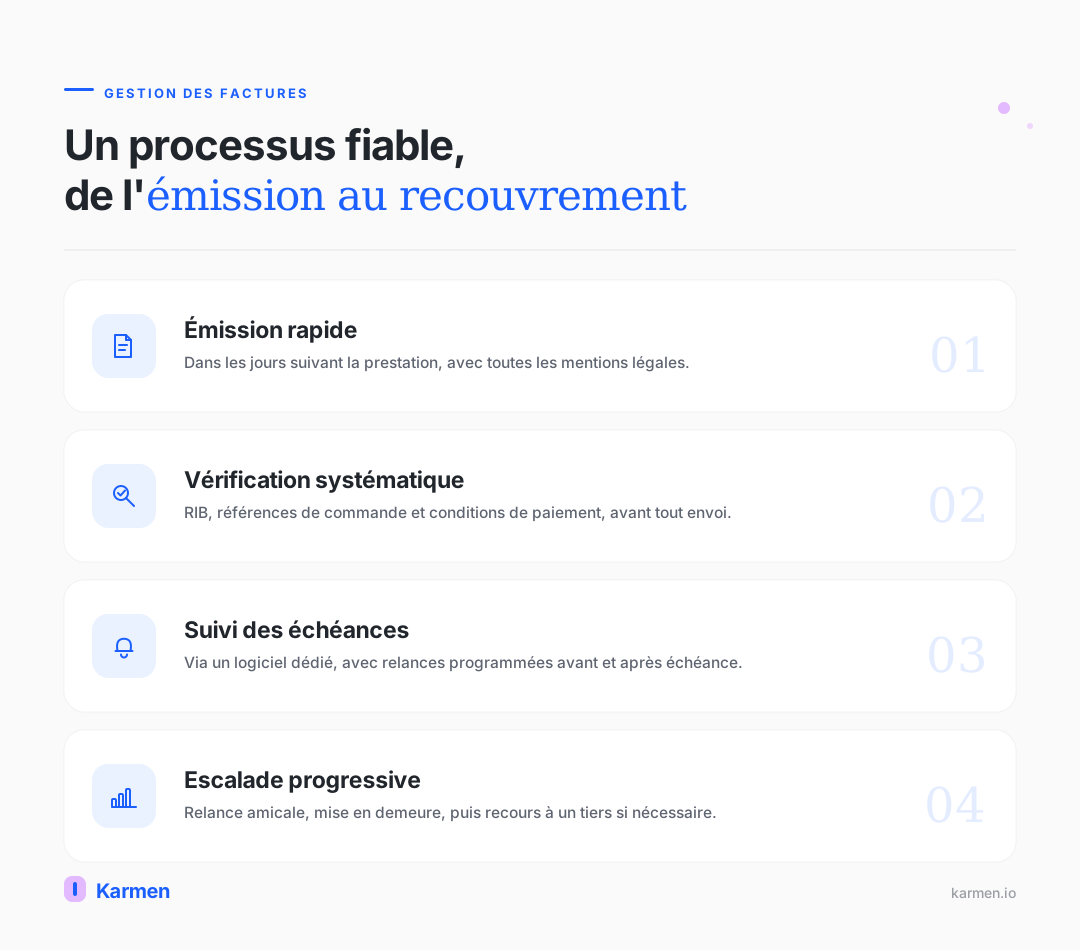
- Prompt issuance of the invoice, within a few days of delivery or service provision, including all mandatory legal information specific to each type of invoice issued (standard, down payment, credit memo).
- Systematic verification of bank account information, order numbers, and payment terms before shipment.
- Actively track deadlines using a calendar or dedicated software, with scheduled reminders before and after the due date.
- A gradual escalation process in the event of a delay: a friendly reminder, a formal notice, and then involving a third party if necessary.
This approach pays off especially when a company needs to quickly access funds from its invoices. A solution forinvoice advance solution makes it possible to free up immediate cash flow from issued invoices, without having to wait for the customer’s contractual due date.
The most overlooked step is still follow-up. Many companies wait fifteen or even thirty days after the due date before making initial contact. That’s a month-long delay that an automated process could have prevented.
An unpaid invoice is one that we're willing to write off as a partial loss.
Electronic invoicing is a game-changer for French SMEs
The reform of business-to-business electronic invoicing, which is being rolled out gradually in France, is transforming the way invoices are exchanged and archived. All businesses will be required, according to a phased schedule based on company size, to issue and receive their invoices via a digital platform. This transition is not merely a regulatory requirement: it necessitates ensuring the accuracy of invoicing data (SIREN numbers, order references, VAT) and automatically makes it easier to track due dates, since each invoice is time-stamped and traceable from the moment it is issued.
Anticipating this transition, rather than waiting until the last minute, makes it possible to implement compatible billing software before the regulatory deadline and avoid having to switch systems twice within a few months. The public sector has, in fact, already taken this step by mandating Chorus Pro to digitize its invoices—an experience that will prove useful in preparing for the upcoming transition in the private sector.
Tools and Metrics for Managing Customer and Vendor Invoices
Managing the billing process involves more than just a spreadsheet. The following metrics provide a reliable picture of the health of the billing cycle:
- DSO (Days Sales Outstanding), which measures the average time it takes for customers to pay, indicates a structural collection problem if it exceeds 60 days.
- The delinquency rate should be monitored monthly rather than annually to detect any trends before they worsen.
- The rate of disputed invoices, which often points to an underlying problem (delivery, quality, product listing).
Effective monitoring of these indicators generally relies on conversion of your accounts receivable to convert an accounting receivable into actual cash, rather than passively waiting for payment.
ℹ️ Real-world example: A B2B service provider that tracks its DSO monthly identifies a shift from 45 to 68 days over three months, due to a new strategic client that consistently pays late. By adjusting the contract terms (requiring a down payment upon signing), the provider reduces the DSO to 50 days in one quarter.
When it comes to tools, a spreadsheet is rarely sufficient once you exceed about thirty monthly invoices. Invoicing software connected to your accounting system automates invoice issuance, schedules reminders, and centralizes the status of each invoice (issued, pending, overdue, disputed). For more established organizations, integration with an ERP system allows this data to be cross-referenced with cash flow forecasts, enabling them to anticipate cash flow constraints several weeks in advance rather than discovering them only at the time of payment.
We launched Karmen Factor to turn your invoices into immediate cash flow
Theoretical approaches aren’t always enough: some companies need quick access to cash without having to wait for more cumbersome internal processes to be put in place. It is precisely to meet this need that Karmen developed Karmen Factor, an invoice financing solution that does not involve the assignment of receivables, designed for business leaders who want to maintain control over their customer relationships while freeing up cash tied up in their outstanding invoices.
Unlike traditional factoring, which often involves outsourcing accounts receivable management, Karmen Factor allows the company to manage its own collections and customer relationships. Financing is activated on a per-invoice basis, according to actual cash flow needs, with no rigid volume commitment over several months.
How can you tell if this type of solution is right for your business? If your customer invoices are regularly more than thirty days past due and your cash flow is being affected by these delays, the answer is probably yes.

Manage In-House or Outsource: How to Choose the Right Approach
The issue isn't about making a definitive choice between in-house management and factoring, but rather about tailoring the approach to the size and maturity of the business. A very small business with five recurring customers can track its invoices manually. A small or medium-sized business with 150 monthly invoices needs a tool and, often, a financing partner.
A few benchmarks can help you make a decision: if you have more than 50 customer invoices per month, dedicated software pays for itself almost immediately. If your average DSO exceeds 60 days, or if a key customer accounts for more than 20% of your revenue and has long payment terms, an external financing solution is worth serious consideration rather than being ruled out on principle.
The decisive factor remains opportunity cost: How much does the internal time spent on follow-ups cost, compared to the actual cost of an external solution? Our analysis of the actual cost of a factoring solution details the commissions, rates, and associated fees that should be compared before making a decision.
Another point to keep in mind: invoice management isn't just about accounts receivable. The financing of your supplier invoices , on the other hand, allows you to spread out your own cash outflows without damaging relationships with your business partners—an aspect often overlooked in cash flow strategies.
What the Commercial Code Says About Payment Terms
The Commercial Code specifically governs payment terms between businesses, whether the transaction involves goods or services. The invoice issue date marks the start of this contractual payment period, while the due date specifies the number of days the debtor has to pay what is owed to the creditor. The amount, including tax, then becomes due and payable, unless a discount has been agreed upon for early cash payment.
Invoicing promptly—as soon as goods are delivered or services are completed—automatically reducesaccounts receivable: the total amount owed that has yet to be collected at any given time. Large companies, which hold a position of strength vis-à-vis their suppliers, often tend to extend their payment terms to the maximum allowed, a practice that regulations specifically address to protect the most vulnerable businesses.
A single late payment can quickly become a habit if nothing is done. When an invoice remains unpaid past its due date, the creditor may impose late payment penalties, possibly supplemented by a flat-rate fine to cover collection costs. These unpaid debts and repeated late payments worsen the accounts receivable balance, while, conversely, supplier invoices not paid on time inflate the company’s own accounts payable balance.
This mechanism explains why paying invoices can never be left to chance. A late payment, or a buildup of unpaid receivables—each situation exacerbates cash flow problems and short-term cash needs. Conversely, companies that collect payments from their customers quickly, while managing their own payments to suppliers, secure their cash flow and future collections over the long term.
Conclusion
Invoice management is never a secondary concern. It directly determines a company’s ability to finance its growth, meet its own obligations, and negotiate confidently with its business partners. Structuring your invoicing process, tracking the right metrics, and knowing when to seek external financing: this three-pronged approach makes all the difference between a cash flow that’s constantly under strain and one that’s well-managed.


