
July 20, 2026
July 27, 2026
Types of Invoices: Which One to Choose and Why It Matters
An invoice isn’t always just an invoice. Whether it’s a standard invoice, a down payment, a credit memo, or a pro forma invoice, each document is designed for a specific situation, and confusing one type with another can be costly: a customer who refuses to pay, an accountant who rejects a document, or a factor who refuses to finance an incorrectly classified document.
This guide provides an overview of the main types of invoices and their required legal information, and explains why choosing the right document directly affects your ability to access working capital through factoring.
The Different Types of Invoices Your Business Can Issue
Any business that sells a product or service handles—even if it doesn’t always call them by name—several types of invoices. Distinguishing them clearly is the foundation of reliable invoice management , and a prerequisite for any financing based on these documents.
- The standard invoice (or sales invoice): the final document, issued after delivery of the goods or completion of the service, which formalizes the receivable and triggers the VAT liability.
- Deposit invoice: issued before delivery, for a partial payment requested at the time of the order, generally between 20% and 50% of the total amount.
- Credit memo: a corrective document that cancels all or part of a previous invoice (returned merchandise, pricing error, goodwill gesture), and which must reference the original invoice.
- The summary invoice: It consolidates multiple services or deliveries over a given period—often monthly—for a single customer, thereby reducing the number of documents that need to be tracked.
- The pro forma invoice: an informational document with no accounting or legal value, sent prior to the sale to confirm a price or terms, and sometimes also used by customs authorities for exports.
This classification is not merely a matter of terminology. It determines what an accounting department can record on the balance sheet, what a customer can legally pay, and what a financing institution can accept as an eligible receivable.
One point that is often overlooked: numbering. Each type of invoice follows its own continuous, chronological sequence (one series for standard invoices, another for credit memos, for example), with no gaps or duplicates during the fiscal year. These documents must then be retained for ten years, either in paper or electronic format—a retention period that corresponds to the requirement in the event of a tax audit or commercial dispute.
Pro forma, corrected, and summary invoices: situations that cause confusion
Why can a pro forma invoice never serve as the basis for financing? Because it does not legally bind anyone: neither the seller to deliver under the specified terms, nor the buyer to pay the stated amounts. It serves solely as a basis for negotiation or as a customs document for an export. A factor will therefore never finance a pro forma invoice, only a final, certain, and due invoice.
A corrected invoice, on the other hand, is different from a credit memo: it does not cancel the original invoice, but rather corrects it (for errors in quantity, product code, or VAT rate) while explicitly referencing it, whereas a credit memo is applied as a deduction. This distinction matters to the tax authorities, which require full traceability between the original invoice and its correction, with the same file number on both documents.
What happens if a customer pays a credit memo as if it were a regular invoice? The payment creates an overpayment that will need to be refunded or applied to a future invoice, and bank reconciliation becomes more complicated for both parties. This is a common mistake among companies that manage their invoicing manually, without dedicated software.
To learn more about all the financing mechanisms related to these documents, the comprehensive guide to factoring explains in detail how each type of invoice fits—or does not fit—into a receivables assignment agreement.
Mandatory legal notices depending on the type of invoice
In France, an invoice (excluding pro forma invoices) must include certain mandatory information; failure to do so may result in the invoice being deemed invalid for accounting purposes and a fine of up to €75,000 for a company, increased to €375,000 in the event of a repeat offense:
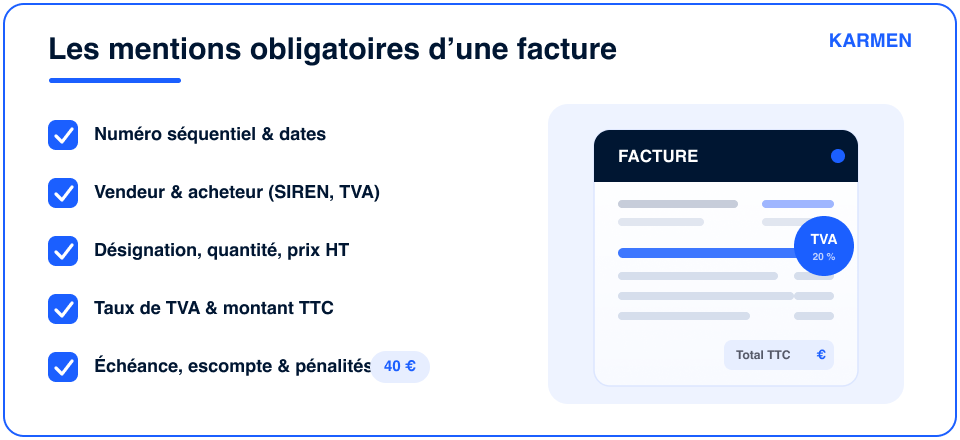
- Sequential, uninterrupted invoice number; date of issuance; and date of sale or service.
- Full identification of the seller and the buyer (SIREN number, address, intra-Community VAT number, if applicable).
- Specific description of goods or services, quantity, and unit price excluding tax.
- Applicable VAT rate and total amount (excluding tax and including all taxes).
- Due date, discount terms, and applicable late payment penalties (fixed rate and a flat-rate collection fee of €40).
These entries are not mere formalities: they determine whether an invoice is eligible for factoring or a Dailly assignment or any other mechanism for factoring receivables. An incomplete invoice may be rejected by a financier, or worse, deemed invalid during a tax audit, resulting in a tax assessment.
Also worth noting: the gradual rollout of electronic invoicing between 2026 and 2027 requires a structured format and transmission via an approved platform, such as Chorus Pro, which is already used to digitize invoices sent to the public sector. This will automatically ensure the reliability of these details but will also require an update to existing invoicing tools.
A well-written invoice provides protection as much as it serves to collect payment.
Issuing a Valid Invoice: What the Law Requires
Creating an invoice involves more than just adding up the prices on each line item. The Commercial Code and the General Tax Code provide specific guidelines on how your invoice must be prepared, regardless of the legal status of the business issuing the invoice: corporation, independent professional, or sole proprietor.
Before creating an invoice, there are a few key steps to follow. All your invoices must include a unique number (the unbroken sequence mentioned above), the exact name of the business and its SIRET number, as well as a description of the service or sale in question—whether it involves goods delivered or services billed monthly. For a self-employed individual, a VAT exemption statement (“VAT not applicable, Article 293 B of the CGI”) must replace the standard rate as long as the exemption threshold has not been exceeded.
Invoicing software automates many of these tasks: it applies the correct invoice template based on the document type (standard, credit memo, down payment), calculates the pre-tax and total amounts, and maintains a record that complies with accounting requirements. For a company that invoices for multiple services each month, this automation significantly reduces the risk of errors or omissions regarding required information when issuing an invoice.
Another sensitive issue is the payment deadline and its corollary, late payment. In certain cases of late payment, the law provides for automatic penalties (the statutory interest rate plus a flat-rate compensation of €40), which must be explicitly stated on invoices in order to be enforceable against the customer. Any discount granted must be clearly stated on the document: it is the invoice amount after the discount that is subject to VAT, not the initial list price.
We launched Karmen Factor to help you pay your bills without having to wait for payment
Issuing the right invoice is one step. Turning it into available cash is another—and that’s often where the problem lies for a growing small business. To address this need, we’ve developed Karmen Factor: financing for your final invoices—without a traditional assignment of receivables—designed for microbusinesses and SMEs that don’t want to wait 30, 45, or 60 days to collect payment for goods that have already been delivered and invoiced.
In practical terms, as soon as a standard or summary invoice is issued and approved, it can be used to obtain an invoice advance, often within a few hours. Down payment invoices and pro forma invoices, however, are excluded from this process: only a certain, liquid, and due receivable can be financed, which by its very nature excludes any provisional documents.

Which Type of Invoice Should You Choose Based on Your Business?
The right choice depends less on accounting preferences than on the company's actual sales cycle and the frequency of interactions with each customer.
ℹ️ A communications agency that works on a monthly retainer basis for a major client is better off issuing a single summary invoice at the end of the month rather than ten separate individual invoices. This simplifies the agency’s collection process, reduces its administrative burden, and makes it easier to collect payment on this single invoice than on a batch of smaller, scattered amounts.
ℹ️ An e-commerce merchant selling custom-made goods often issues a 30% deposit invoice at the time of order, followed by a standard invoice for the balance upon delivery. Only this second, final invoice is eligible for financing: this is something many people discover too late, once their cash flow has already been strained by the production of the product.
This line of reasoning naturally leads to the following question: Which financing solution best matches the actual volume and nature of your invoices? To decide, which factoring solution to choose outlines the criteria (one-time, recurring, confidential) based on your situation and the structure of your accounts receivable.
In both cases, the billing frequency directly affects how quickly a company can access its cash flow. Consolidated monthly billing is easier to finance than a daily stream of small invoices, but it also extends the time between the actual service and the issuance of the invoice—a trade-off that should be weighed based on the size of the amounts involved.
Conclusion
Choosing the right type of invoice is not just a one-time administrative formality: it determines whether a document is legally binding on your customer, whether it will stand up to a tax audit, and, above all, whether it can be converted into immediate cash flow rather than remaining as a receivable sitting on the balance sheet for 45 days.
Standard, down payment, credit memo, pro forma, or summary: Each invoice serves a specific purpose, and some of them open the door to quick financing of your accounts receivable.


