Whether you're an entrepreneur running an SME, a mid-sized company, a very small business, or an innovative startup, your choice of financial intermediary will determine the success of your capital increase.
Securing funding for your fundraising campaign can’t be done on the fly: it requires drafting a meticulously detailed business plan and, above all, direct access to the top experts in financing solutions. We designed this exclusive tool specifically to help you accelerate your search for funding.
What is a fundraiser, and what is their role?
A fundraiser is a specialist who assists entrepreneurs with their financing needs for business start-ups, growth capitalprojects, or the acceleration of their startups. Their role is to bridge the gap between a company’s need for equity capital and the expectations of capital providers, such as private investors, business angel networks, family offices, or major private equity and venture capital funds.
As a true strategic partner, it reviews your financing structures, optimizes valuation, and coordinates the onboarding of each new shareholder. Its goal? To enable founders to bring their projects to fruition quickly through strategic capital.
Prepare Your Investment Before Approaching an Investor
Before hiring an expert to help finance its project, a company must structure its initial share capital. An investor will only get involved if the founders demonstrate a strong commitment. A fundraising specialist will help you highlight these aspects before launching the roadshow:
Cash contributions: This refers to cash deposited directly into the company's checking account or added to its capital.
Contributions in kind: Patents, technologies, equipment, or technologies transferred to the company.
Self-Funding and "Love Money": Initial capital from family and friends or from internal cash flow. These demonstrate to investment funds the viability of the seed stage.
Structuring the Right Financing Mix (On- and Off-Balance Sheet)
A successful fundraising round is almost never limited to equity (opening up the company's capital). To avoid massive dilution of the founders' stakes, experienced fundraisers structure a hybrid model that combines several sources of funding.
1. Equity Financing (Dilutive)
This is the core of fundraising: opening up the company’s equity to an investor or business angels in exchange for shares in the company. This type of financing provides significant liquidity to drive growth but changes the company’s governance structure.
2. Non-dilutive financing (debt, loans, and grants)
To supplement cash contributions, the fundraiser will seek out additional financing solutions that preserve your share capital:
Public Support: Obtaining a grant, an interest-free loan (often at zero interest), orpublic assistance from bpifrance.
Traditional Bank Loans: Negotiate a medium-term bank loan or a traditional bank loan to finance capital investments. The fundraiser helps you negotiate the collateral (such as a personal guarantee) required by banks.
Alternative financing: Integration of crowdlending campaigns, leasing solutions , microcredit, and non-dilutive financing providers, such as Karmen
The Categories of Listed Financing Experts
To successfully secure funding for your small business, microbusiness, or startup, it is essential to choose the right type of investor based on your industry and the stage of your business.
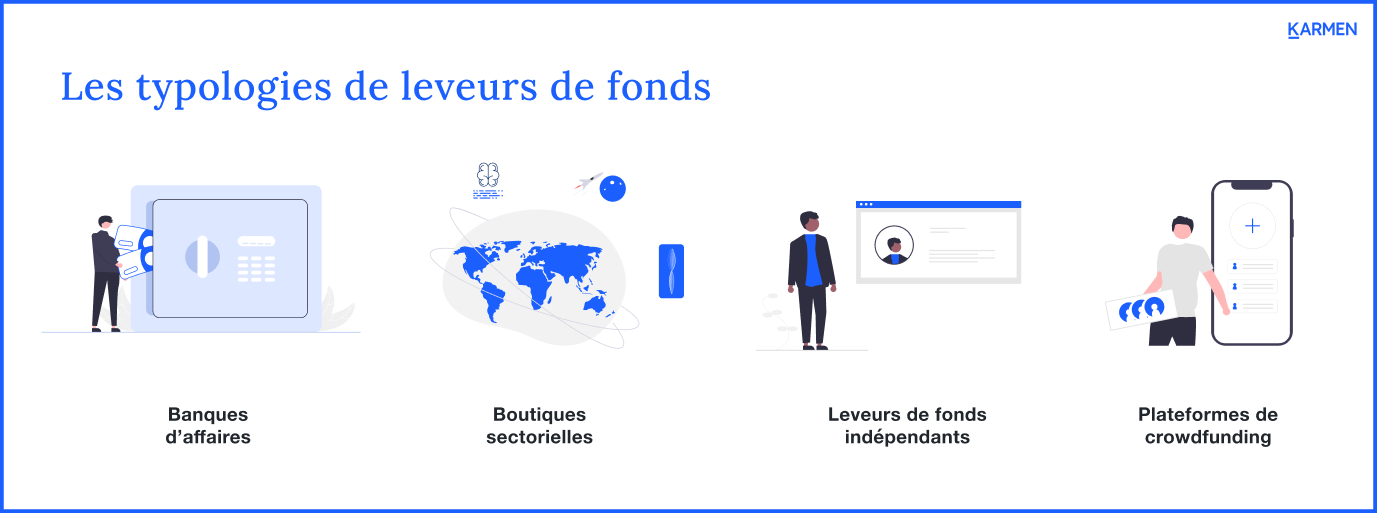
Independent fundraisers: Agile experts who are ideal for financing your business from the earliest seed stages or for a business acquisition. They have a direct line to business angels.
Sector-specific fundraising firms: Ideal for providing equity financing to innovative companies (Tech, Healthcare, Deep Tech) that require large venture capital investments.
Crowdfunding platforms: An excellent way to involve your community in funding the business.
Investment Banks: For large-scale transactions: major funding rounds, hybrid equity/debt transactions, strategic M&A, and pre-IPO transactions.
How to Choose the Right Fundraiser?
Key Selection Criteria
Before signing a contract, evaluate the professional’s track record: Has he or she successfully secured funding for similar projects? Does he or she understand your cash flow challenges, your repayment deadlines, and your ambitions for international expansion?
Important note: A good fundraiser must balance your sources of financing so that your overall debt does not place too heavy a burden on your working capital (WCC).
Access the Fundraisers Directory Now
Don't launch your roadshow blindly. Gain a clear understanding of the ecosystem to secure funding for your business and reach out to the ideal intermediary.
Designed to assist with decision-making, our resource guides you through every step of your selection process:
A comparison table with filters (over 70 investors): to instantly filter profiles based on your industry, the funding stage (Seed, Series A, B), and your ideal investment amount (from €300K to over €30M).
Mapping Stakeholder Types: To Determine Whether Your Project Falls Under the purview of a Specialized Firm, an Investment Bank, an Independent Fundraiser, or a Crowdfunding Platform
Our Recommendations: Expert advice on how to choose the right filters based on your project’s actual progress, your industry-specific characteristics, and your need to stand out.
If you're interested in this topic, we've put together some other free resources that you might also find useful: