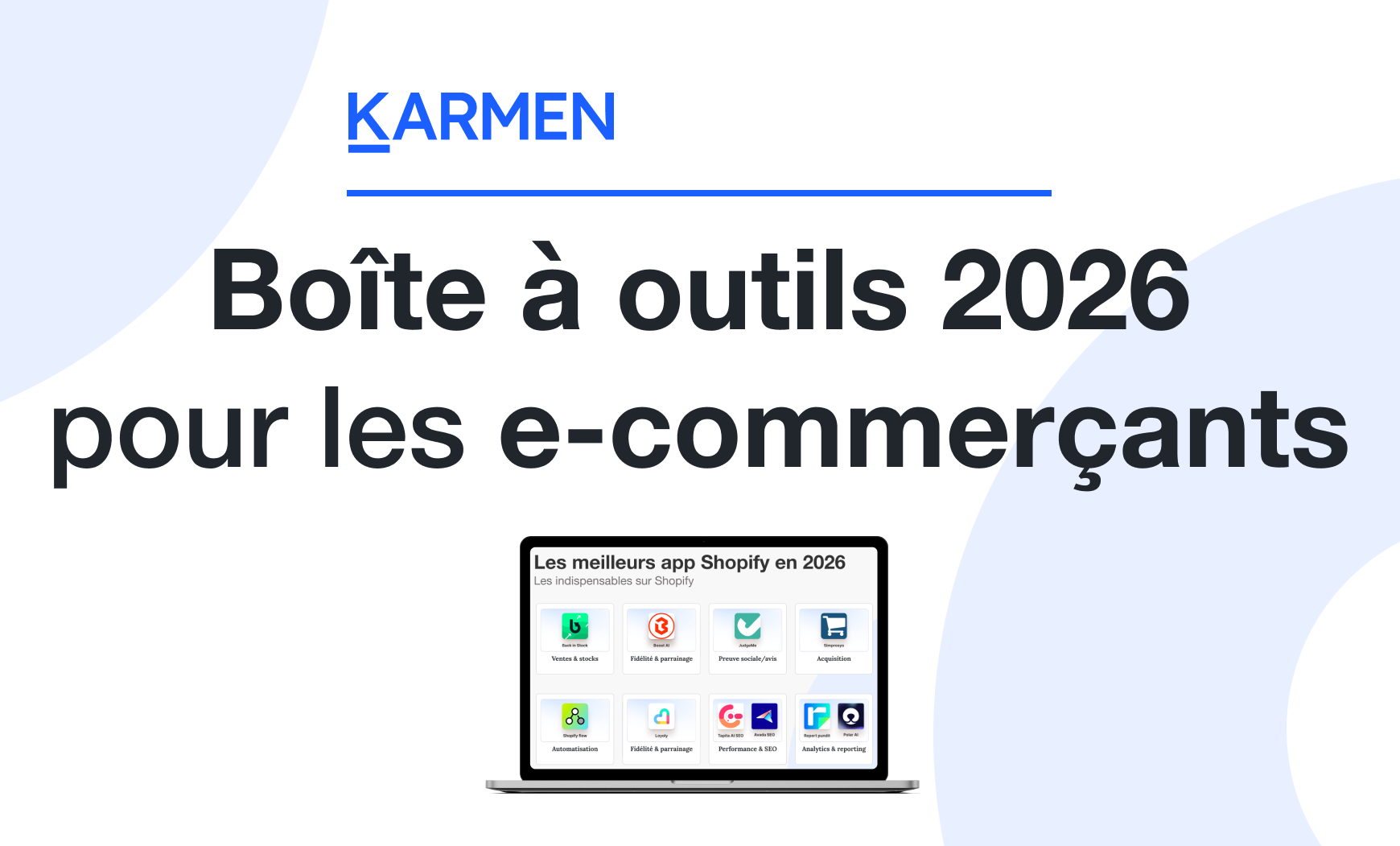
🧰 The 2026 toolkit for e-merchants
- Recommended tools for e-commerce and their presentation
- Comparative tables between the different tools
- Useful AI tools for e-commerce creation and optimization
- A bonus section on the best Shopify apps

Do you have an online store or are you looking to improve your current stack? You know that your choice of tools will determine your growth... but you're overwhelmed by the options, or your software isn't compatible enough with each other.
The problem? Between publishers' marketing promises, conflicting opinions on forums, and dozens of tools that all claim to be "the best," it's impossible to know where to start. In the end, you waste money and time on testing, migrations, and subscriptions that aren't necessarily useful.
The entrepreneurs we support at Karmen regularly ask us what technical stack other e-merchants use, so they can optimize their own. In response to this recurring need, we decided to create a dedicated resource: a practical guide designed to offer a turnkey stack, focusing on compatibility and consistency between tools rather than simply listing the best tools currently available.
✅ You already have an e-commerce site, but your current stack is wasting your time
✅ You are considering migrating to new solutions
✅ You want to optimize your costs
✅ You are looking to scale up, but your current infrastructure can no longer keep up
✅ You are launching your first online store and don't know where to start
In this resource, we share the solutions that we see working for the e-merchants we support on a daily basis. For each category, you will find 1 to 3 tools with a simple comparison that describes their specific features.
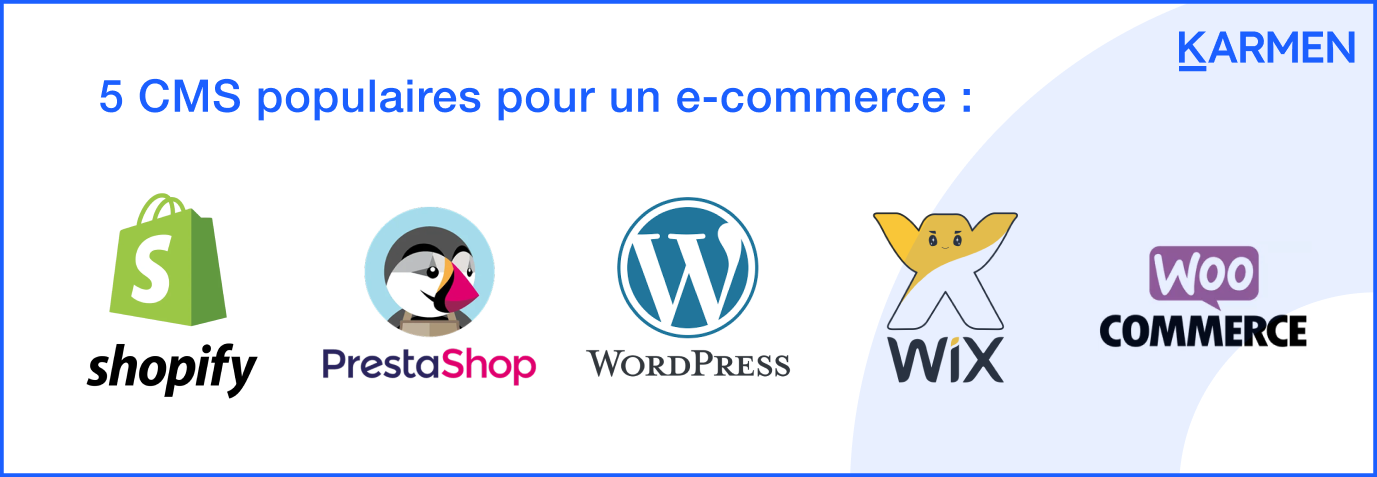
E-commerce CMS: your sales platform is your foundation. Your choice determines everything: your ability to customize, evolve, and integrate your other tools.
Examples of popular CMSs:
Payment solutions: your PSP manages much more than just payment collection. It orchestrates the payment process, optimizes fraud prevention, and automatically reconciles your transactions. The wrong choice will have a direct impact on your conversion rate.
Accounting: E-commerce has specific needs that traditional software does not cover. Multi-currency payments, automatic transaction reconciliation, shipping cost management, synchronization with your payment platforms... We'll show you the tools designed for this.
Business banking: manage multiple currencies, make international transfers, automatically export data to your accounting software, create virtual cards for each service, etc. Some banks are designed for e-commerce, while others are less so.
CRM: centralize customer history, automate follow-ups, and personalize your communications on a large scale. Your CRM directly impacts your retention rate and lifetime value.
Logistics: inventory management, shipment coordination, customer tracking. These tools influence your delivery experience and your ability to scale without compromising quality.
Advertising: Meta Ads, Google Ads, TikTok... Platforms are constantly evolving with new automation features. We help you identify where to focus your efforts.
Prospecting: for those who develop in B2B or who are looking for partnerships, prospecting and calling tools make it possible to industrialize the approach while maintaining the human relationship.
Automation: connect your tools to each other to avoid re-entering data, prevent errors, and save time on repetitive tasks. Workflows can orchestrate complex actions between multiple systems.
Artificial intelligence: content generation, SEO optimization, visual creation, product sheets, advertising... Almost everything can be optimized. We focus on practical uses that reduce your time to market.
For each category, we compare the tools we have selected with their specific features: who they are aimed at (small or large volumes, technical skills required or not), sectors, what sets them apart, and in which cases they are relevant.
No definitive ranking, just enough to quickly understand whether a tool is right for your situation or not and make your choice for your final tool stack.
There are dozens of AI tools available, sometimes even for the same needs. Here are the criteria for those highlighted in this resource that will save you time:
This bonus section is for e-merchants on Shopify (or those planning to switch to this platform). The goal is to save you hours of research. We've sorted through the 8,000+ apps available and narrowed it down to just 13. They include features that help optimize:
At Karmen, we finance the growth of hundreds of e-merchants. When we talk to them about their business to offer them financing, we often end up discussing figures, tools, and technical stacks. We see what works, the trends, and what wastes time and money.
And we noticed recurring issues:
Tools that don't communicate with each other. Some customers wasted hours re-entering the same data, copying and pasting between their CMS and their accounting software, and manually reconciling their payments.
Technical choices made too quickly at launch. The CMS does not support split payments, and the payment solution charges an excessive 2% commission. As a result, when e-commerce grows, migration is to be expected.
Tool budgets that skyrocket for no reason. Between multiple SaaS subscriptions, custom integrations, and transaction fees, the bill at the end of the month can quickly add up.
This toolkit is our way of sharing what we have learned from financing e-commerce businesses across all sectors.
Karmen is a quick and easy financing solution designed for e-merchants (response within 48 hours). We finance needs with a quick return on investment: inventory, recruitment, social media campaigns, operational growth, etc. With loans ranging from €30,000 to €5 million, over 1 to 24 months, with no personal guarantees or hidden fees.
There is no such thing as a perfect stack for all e-merchants, but there are better decisions to make depending on your stage, constraints, and objectives.
This toolkit is 100% free and aims to save you time, avoid costly mistakes, and build a consistent stack, whether you are in the launch or scale phase. Use it as a basis for auditing your current stack, preparing for migration, saving time, or structuring your first store on a solid foundation.
If this topic interests you, we have compiled other free resources that may also be useful if you are an e-merchant: